


_edited_edited_edited.png)
Water crisis: AUB and UNU-INWEH Reveal the threat facing groundwater resources
June 7, 2026
In response to the precipitous decline of groundwater levels recorded across 116,000 wells, the AUB and UNU-INWEH are urging the media to abandon "Firefighting journalism" in favor of long-term investigative reporting.
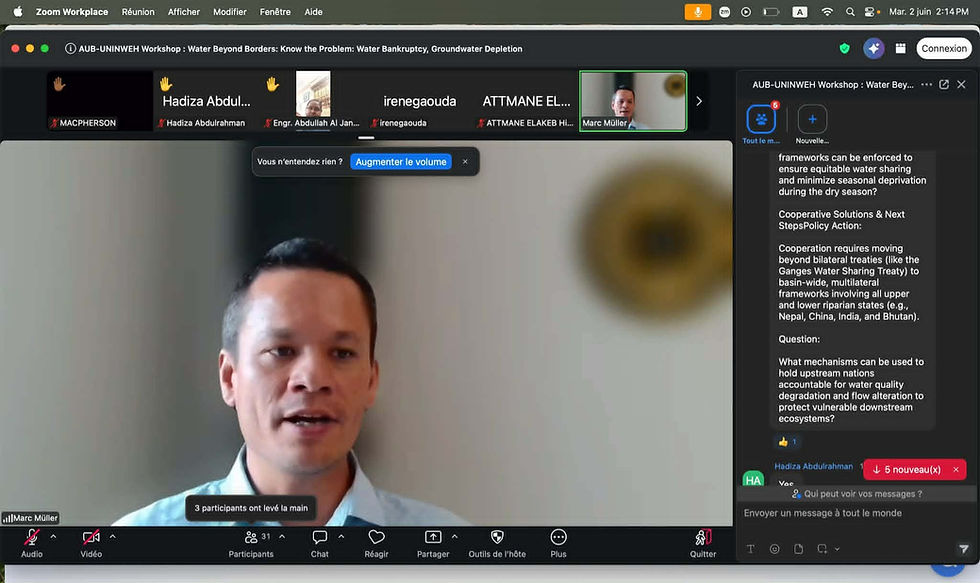
Water scarcity is no longer just a climate fatality, but a profound crisis of governance. This was the stark warning issued by scientists, policymakers, and media executives at the virtual workshop, "Water Beyond Borders: Addressing Water Bankruptcy, Groundwater Depletion, and Transboundary Governance."
Co-organized by the African Broadcasting Union (AUB) and the United Nations University Institute for Water, Environment and Health (UNU-INWEH), the webinar lifted the veil on an invisible geopolitical threat: the rapid depletion of aquifers—the subterranean geological formations and porous strata that store and transmit groundwater across international borders.
The transboundary effect and the hidden crisis
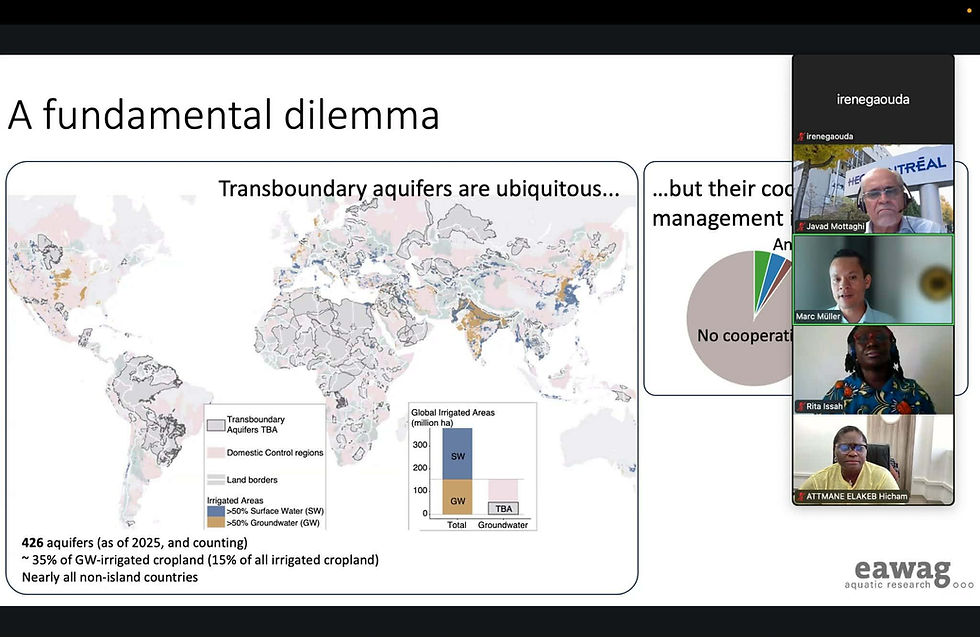
While surface water systems like the Nile or the Niger frequently dominate geopolitical headlines, the planet’s fossil water reserves are being silently exhausted. To quantify this threat, Dr. Marc Müller and his research team at UNU-INWEH conducted a global analysis, pulling back the curtain on data from more than 116,000 observation wells worldwide.
To understand the crisis they uncovered, imagine a massive underground water tank shared by next-door neighbors who never talk to each other. Globally, there are 426 transboundary aquifer systems, which provide more than one-third of the water required for groundwater-dependent irrigation. In Africa, where small family farms are the lifeblood of communities, this invisible water is the literal backbone keeping local markets stocked and families healthy.
Yet, a dangerous gap exists. While almost every country shares underground water with a neighbor, fewer than 10% actually have a formal treaty to manage it together. Without common rules, these border-crossing reserves are drying up at a staggering rate, losing roughly 9 million cubic meters more water every single year than underground water supplies contained safely inside a single country.
Surprisingly, Dr. Müller’s research proves that this rapid depletion isn't caused by hostile nations trying to steal water from one another. Instead, because international borders are frequently drawn along rivers, agricultural activity naturally intensifies right along these borderlines. This causes farmers on both sides to unintentionally over-pump the shared underground water reserves.

Management without a credit limit
This lack of clear rules is causing real-world disasters, and West Africa is already in the danger zone. Following Dr. Müller's global overview, Rita Isaka of the Ghana Broadcasting Corporation (GBC) introduced a chilling analogy to contextualize the crisis: groundwater serves as a non-renewable "savings account," surface water is a limited "checking account," and rampant pollution is akin to writing bad checks against future generations."West Africa is currently spending more water than it earns, operating with no credit limit," she warned.
More than 400 million people rely on these shared water resources region-wide, with 70% of the population depending on them exclusively for their daily survival. Driven by demographic growth and climate change, this vital asset is shrinking rapidly. Hydrogeological models warn that per capita water availability in West Africa will drop by 40% by 2050.
Ghana provides a striking example of this immediate threat, driven largely by 'galamsey,' which is widespread illegal gold mining. These open-pit mines are rapidly draining underground water reserves, while toxic mercury contamination from the mining sites has skyrocketed to an astonishing 361 times above the safety limits set by the World Health Organization, Isaka noted. To make matters worse, over-pumping has caused saltwater from the ocean to leak into freshwater supplies along the coast, causing massive financial damage. If this trend continues, experts warn that Ghana could be forced to import basic drinking water by as early as 2030.

Voices from the frontline
Moderated by Gisèle Salomé Nnemi Nga, Editor-in-Chief of the AUB Content Exchange Center, the workshop brought scientific data face-to-face with stark ground realities.
From Daura, on the border between Nigeria and Niger, Aliyu Rabe bore witness to the impacts of climate change. Driven by drying dams and rapid population growth, the unregulated surge in domestic boreholes has caused underground water levels to plunge by 5 to more than 10 meters, leading to a rash of failed drillings. Combined with deforestation, this water depletion is accelerating the advance of the desert.
The issue extends far beyond Africa. Abdulah Al J. Newaz from Bangladesh highlighted the plight of his country, which shares 57 border-crossing rivers, predominantly with India. He noted that upstream dams have drastically reduced dry-season flows, triggering severe droughts and coastal salinity. In response, Dr. Müller emphasized that Bangladesh’s accession to the UN Water Convention marks a critical step forward, shifting local disputes toward international laws that guarantee fair water sharing and protect neighboring countries from harm.
In contrast, MacPherson Mukuka, a participant from the Zambia National Broadcasting Corporation (ZNBC), shared his country's model, which holds 40% of Southern Africa's freshwater. To protect the permeable ground in Lusaka and prevent underground water collapse, Zambia created the Water Resources Management Authority (WARMA). Today, drilling a borehole requires a legal permit, and users are redirected to public surface water if a water source is being overused. Zambia also co-manages the Zambezi River Authority with Zimbabwe to regulate water for the Kariba hydroelectric dam.
The end of "Firefighting Journalism"
Who is responsible for raising the alarm about these invisible borders and bankruptcies? The webinar challenged the media's current approach to environmental reporting.
In this regard, the President of the African Media Network for RAM/WASH, Moussa Thiam, urged newsrooms to abandon "firefighting journalism"—the practice of covering water only during floods or droughts, then dropping the subject once the immediate disaster fades.
Instead, he advocated for "solutions journalism" driven by data, urging reporters to use open-source satellite tech like GRACE-FO to track groundwater depletion and pair it with local human stories. “The media has a duty to place humanity, ethics, and collective responsibility at the center of the public agenda,” Thiam stated, urging reporters to give a voice to the rural women and children who bear the disproportionate brunt of the crisis.
The session highlighted the urgent need for regional frameworks, such as a West African Groundwater Charter and an ECOWAS Water Court to enforce the "Polluter Pays" principle. The economic truth is clear: one dollar invested in water protection today saves ten dollars in future treatment and import costs.

A path forward
The June 02, 2026 Webinar marked the operational launch of a historic MOU signed earlier this year in Senegal, a milestone highlighted during the session by the African Union of Broadcasting’s Director General, Grégoire Ndjaka. Praising the strategic partnership with UNU-INWEH, Mr. Ndjaka emphasized that the alliance's primary goal is to bridge the gap between scientists and the media. He also extended his profound gratitude to Dr. Javad Mottaghi of HEC Montreal, whose instrumental efforts made this crucial collaboration a reality.
As a result of this partnership, the AUB now runs the African Secretariat of the UNU’s Global Media Academy. Coordinated by Irene Gaouda Lyoum, this initiative delivers specialized programs to equip broadcasters with vital scientific literacy. To further incentivize this reporting, the co-organizers announced the Global Media Awards 2026 during the webinar, under the theme "Water Bankruptcy: Every Drop Counts."
Water is running out, but the tools to manage it and the platforms to report on it are within reach. The media must now ensure that the public and policymakers alike treat every drop as an invaluable security asset. To maintain this momentum and further empower journalists across the continent, the "Water Beyond the Borders" webinar series will continue throughout the year.
Irene GAOUDA


Comments